
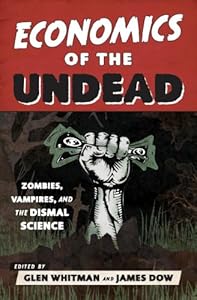
Could zombies and vampires become a productive part of the labor force? At least two chapters in Economics of the Undead (11 and 14) suggest the answer is yes; indeed, Chapter 14 even addresses how they should be taxed. But what sort of jobs would they take? Two recent news stories suggest answers. First, apparently zombies are already sacking groceries – a suitably mindless task, though I worry they might put the eggs at the bottom of the sack. Second, it seems that at least one vampire has become a gigolo, although the outcome wasn’t exactly an advertisement for undead in the workforce.
Category Archives: Uncategorized
Return of the Undead Metaphors
Earlier this week, I assembled a partial list of zombie metaphors. Three more have come to my attention since then: zombie funds, zombie statistics and zombie fleets.
Vampire metaphors don’t seem quite as common, but I’ve found a few. In addition to vampire squids (discussed in Jim’s last post), we also have vampire cable boxes and the vampire state.
And based on these few data points, I’m ready to make a generalization. Even though both zombies and vampires have risen from the dead and are hard to kill, and both zombies and vampires feed on humans, when it comes to metaphors there’s a segregation at work. Zombie metaphors almost exclusively reference the risen-from-the-dead or hard-to-kill quality, whereas vampire metaphors almost exclusively reference the feeding-upon-us aspect.
Why the difference? The focus on feeding by vampires is a bit easier to explain, because the vampire metaphors highlight not just the feeding, but also its parasitic quality — that is, the tendency to drain energy without killing the host. For example, the vampire cable box doesn’t kill you or your household; it just drives up your electricity bill. Zombies, on the other hand, kill and/or convert anyone they feed upon, which makes them less useful for parasite comparisons. As for why zombie metaphors focus on the risen-from-the-dead quality, I suspect it’s because zombie horror emphasizes how they keep on coming no matter what you do — despite the fact that both zombies and vampires can be exceedingly difficult to dispatch permanently.
Death by Econ
What did I learn from “Zombie High,” a film made by students at Oak Park High in Winnipeg? That zombie teachers teach economic history, and that their lectures can zombify students without physical contact. Go to the 8:05 to see what I mean. If only he had taught economics of the undead instead of economics while undead, his students might have been spared…
Zombie Welfare
In Chapter 20 of Economics of the Undead, the Phillips clan use the “graveyard vote” to investigate where the undead reside in the United States. If there’s any doubt as to the reliability of that method, perhaps they could replicate the study using zombie welfare recipients instead of graveyard voters. There’s also an intriguing question as to whether these zombies on welfare are welfare cheats, as everyone seems to assume, or if they’re just zombies who have fallen on hard times and need a helping hand.
Incidentally, this article appears in the Pennsylvania Independent, whose URL looks like “pain dependent.” I’m just saying.
Morgan Freeman, Vampire Vegetarian
Can vampires live without human blood? Yes, as we’ve learned from Anne Rice’s Louis, Buffy’s Angel, and Stephenie Meyer’s Cullen clan. But it seems the Electric Company got there first, in 1972, with Morgan Freeman’s turn as “Vincent the Vegetable Vampire.” No, he’s not a vampire hospitalized after a traumatic brain injury; he just likes eating vegetables. By the way, Bunnicula, another vegetable-draining vampire from my childhood, is now available on Kindle.
Vampire Squids
In the wake of the recent financial crisis, the role of the financial system in the economy has been under debate, with some arguing that it needs a complete overhaul, while others making the case that it’s mostly doing fine as it is right now. In the latter camp was Lloyd Blankfein, CEO of Goldman Sachs who said that financial institutions were “doing God’s work”. He received a fair amount of criticism for that statement, but I think they missed the point. The real question is – which god?
Perhaps Matt Taibbi gave us a hint with his famous description of Goldman Sachs as a “a great vampire squid wrapped around the face of humanity, relentlessly jamming its blood funnel into anything that smells like money”
Here’s what an actual vampire squid looks like. But while a vampire squid may sound scary, it’s far too natural of a creature for us at Economics of the Undead. So I’d like to suggest that Blankfein may have had a different cephalopod in mind.
Zombie Metaphors Keep on Coming
Are there non-human zombies? Yes, they’ve been documented in a number of cases, most recently Zombeavers, as well as some non-fiction zombie animals created by parasites.
But what about non-human, non-organic zombies? Those exist, too, but mostly in the realm of metaphor. In the past, we’ve seen zombie banks and zombie economic theories. More recently, we’ve seen zombie foreclosures, zombie health plans, zombie scientific studies, zombie airline tickets, zombie spacecraft, and zombie venture capital firms.
Are there any examples of non-human, non-organic, non-metaphorical zombies? Would the computers in a botnet count? What if they were incorporated into the net by means of a computer virus?
Blood Markets in India
As though to confirm the arguments in Enrique Guerra-Pujol’s chapter, “Buy or Bite?”, Wired brings us an excerpt from Scott Carney’s new book The Red Market, which documents the illicit trade in blood, bones, organs, and other body parts. The excerpt tells the story of an Indian man held captive in a blood-letting factory:
For the last three years the man had been held captive in a brick-and-tin shed just a few minutes’ walk from where the farmers were drinking tea. The marks on his arms weren’t the tell-tale signs of heroin addiction; they came from where his captor, a ruthless modern-day vampire and also a local dairy farmer and respected landowner named Papu Yadhav, punctured his skin with a hollow syringe. He had kept the man captive so he could drain his blood and sell it to blood banks.
In total, Yadhav held some 17 people captive in this fashion in what came to be called “The Blood Factory.” An argument against markets in blood, you might think… until you realize that in fact, selling blood is already illegal in India. These poor souls are the victims of black markets in blood, created by the illegality of blood sales (along with the general unwillingness of Indians to donate blood voluntarily). Carney vividly describes the process by which spot transactions turned into a form of slavery:
The $3 he gave for a pint of blood would buy food for several days. It was illegal, but it was also easy money. Yadhav could easily turn over common blood types for $20 quick profit, while rarer groups could fetch up to $150 a pint. It didn’t take long for the situation to deteriorate. As his operation grew, he got tired of trolling the city’s transit points. So Yadhav offered the donors a place to stay. With the men under his roof, it was only a matter of time before he took control of their fates though a mixture of coercion, false promises, and padlocked doors.
The buyers of blood, it turns out, are legitimate hospitals and medical clinics desperately in need of blood and unable to get enough through legal channels. One could argue that the true culprit here is economic deprivation, the existence of people desperate enough to make a living selling their blood. But it seems unlikely to me that, in a legal market for blood, holding people hostage in a secret Blood Factory would be a more economical business model than simply paying for their donations. Wherever we lay the blame, this much is clear: the law cannot eliminate markets for valuable resources; it can only drive them underground.
Getting Ready for the Zombies
Lots of people, including National Geographic, are using the coming zombie apocalypse as a way to introduce disaster training in a humorous way. But it does raise an important question since we face a variety of different disasters in addition to zombies. How much should you prepare for a potential disaster? The standard economic answer is that you should compare the cost of making preparations with the expected benefits from surviving a disaster in the future (expected benefits are the benefits from preparation multiplied by the probability that the event happens). The basic idea is that the higher the probability of the event, or the worse the event is, the more you should spend in preparation. It’s worth it to prepare for a low cost but high probability event like an ice storm. It’s also worth it to prepare for a high cost but low probability event like a big earthquake.
But you want to be careful not to confuse the extremity of the event with the benefits of preparation. As the dangerousness of zombies increases, it seems like you should spend more on preparations; however, if you imagine zombies to be so dangerous that no one will survive, then it’s optimal not to prepare at all. National Geographic asked their interns about how they would fare when the zombies come. My interpretation of Caroline’s curl-up-and-die strategy is that she is indeed taking a rational response to expectations of a very extreme zombie event. Josh too, although he’s definitely looking on the bright side.
“True Mud”
Sesame Street has released a parody of “True Blood” called “True Mud” — which, as you’ll see, raises two questions: (1) Are grouches undead? (2) Given grouchy preferences, does mud have any viable substitutes? (Okay, I know it’s a stretch. But I still find Sesame Street sketches funny after all these years.)
Recent Comments

Dean McClelland (@De… on Tontines: How Vampires Really… enrique on Peak Blood? enrique on Blood Markets and Blood C… enrique on Reopening the Case for Blood… Dan Cortez on Reopening the Case for Blood…


 Economics of the Undead