Author Archives: Glen Whitman

Zombie Metaphors Keep on Coming

Are there non-human zombies? Yes, they’ve been documented in a number of cases, most recently Zombeavers, as well as some non-fiction zombie animals created by parasites.

But what about non-human, non-organic zombies? Those exist, too, but mostly in the realm of metaphor. In the past, we’ve seen zombie banks and zombie economic theories. More recently, we’ve seen zombie foreclosures, zombie health plans, zombie scientific studies, zombie airline tickets, zombie spacecraft, and zombie venture capital firms.

Are there any examples of non-human, non-organic, non-metaphorical zombies? Would the computers in a botnet count? What if they were incorporated into the net by means of a computer virus?


Blood Markets in India

As though to confirm the arguments in Enrique Guerra-Pujol’s chapter, “Buy or Bite?”, Wired brings us an excerpt from Scott Carney’s new book The Red Market, which documents the illicit trade in blood, bones, organs, and other body parts. The excerpt tells the story of an Indian man held captive in a blood-letting factory:

For the last three years the man had been held captive in a brick-and-tin shed just a few minutes’ walk from where the farmers were drinking tea. The marks on his arms weren’t the tell-tale signs of heroin addiction; they came from where his captor, a ruthless modern-day vampire and also a local dairy farmer and respected landowner named Papu Yadhav, punctured his skin with a hollow syringe. He had kept the man captive so he could drain his blood and sell it to blood banks.

In total, Yadhav held some 17 people captive in this fashion in what came to be called “The Blood Factory.” An argument against markets in blood, you might think… until you realize that in fact, selling blood is already illegal in India. These poor souls are the victims of black markets in blood, created by the illegality of blood sales (along with the general unwillingness of Indians to donate blood voluntarily). Carney vividly describes the process by which spot transactions turned into a form of slavery:

The $3 he gave for a pint of blood would buy food for several days. It was illegal, but it was also easy money. Yadhav could easily turn over common blood types for $20 quick profit, while rarer groups could fetch up to $150 a pint. It didn’t take long for the situation to deteriorate. As his operation grew, he got tired of trolling the city’s transit points. So Yadhav offered the donors a place to stay. With the men under his roof, it was only a matter of time before he took control of their fates though a mixture of coercion, false promises, and padlocked doors.

The buyers of blood, it turns out, are legitimate hospitals and medical clinics desperately in need of blood and unable to get enough through legal channels. One could argue that the true culprit here is economic deprivation, the existence of people desperate enough to make a living selling their blood. But it seems unlikely to me that, in a legal market for blood, holding people hostage in a secret Blood Factory would be a more economical business model than simply paying for their donations. Wherever we lay the blame, this much is clear: the law cannot eliminate markets for valuable resources; it can only drive them underground.


“True Mud”

Sesame Street has released a parody of “True Blood” called “True Mud” — which, as you’ll see, raises two questions: (1) Are grouches undead? (2) Given grouchy preferences, does mud have any viable substitutes? (Okay, I know it’s a stretch. But I still find Sesame Street sketches funny after all these years.)


The Strain and Vampiric Communism

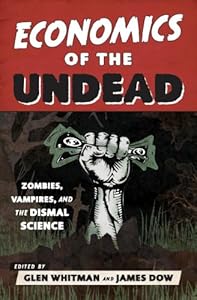
July 13th will see the premiere of yet another vampire TV show: Guillermo del Toro’s The Strain on FX. I haven’t read the books on which the series is based, but going by the Wikipedia page, The Strain marks a sharp departure from the modern trend of handsome, charming, almost-human vampires that young ladies will swoon for – and a return to the vampire as a creature of horror. I guess most of my tips on mating and dating vampires (chapters 1 and 2 of Economics of the Undead) will prove useless here.

Moreover, since The Strain also treats vampirism as a kind of contagion that spreads rapidly in the population, this show may have more in common with recent zombie tales than with your usual vampire story. The problem for the human population is obvious: how to avoid an epidemic and mass conversion. What’s less obvious is that the vampires, too, face a problem. A virus that infects and kills (or in this case, converts) too quickly, without allowing the prey population to replenish itself, will sow the seeds of its own extinction. We might, therefore, expect the virus to evolve into a less virulent form – a possibility explored in a chapter by Kyle Bishop, David Tufte, and Mary Jo Tufte (“What Comes Next? Endgames of the Zombie Apocalypse”), as well as a Saturday Morning Breakfast Cereal comic strip. To the extent that the vampires are thinking creatures who can apprehend their situation, they may devise deliberate strategies to avoid overfeeding; for more on that, see my chapter entitled, “Tragedy of the Blood Common: The Case for Privatizing the Humans.”

The Strain Wikipedia page (again, my only source) also indicates that Strain vampires share a form of hive mind with the Ancient from whom they are “descended” as well as all other vampires of the same line. This raises an economic question that doesn’t arise in Economics of the Undead: could central planning work better for the undead than for humans?

There is fairly broad (though not universal) agreement among economists that central planning fails in human societies, like the USSR and Maoist China, for two primary reasons. First, humans lack the incentive to follow the dictates of a central planner, preferring instead to pursue their own interest as they see it. Second, central planners don’t have access to the local and often tacit knowledge of economic circumstances (preferences, resource availabilities, and technologies) that is dispersed among thousands of people. The price-and-profit signals of a decentralized market society help to solve these twin problems. But both problems might fade away in the context of a vampire hive mind; all the knowledge of the hive is automatically shared via telepathic link, and all incentive problems vanish in the face of mind control by the Ancient in charge. As a result, the community of vampires descended from one Ancient might become a successful communist society, just like a bee hive or ant hill.

However, the Wikipedia entry also implies (without saying outright) that each Ancient’s hive mind is separate from every other Ancient’s hive mind. If so, and if there are enough Ancients alive and trying to interact with each other, then the community of Ancients might need to rely on a decentralized market to coordinate their activities after all.